
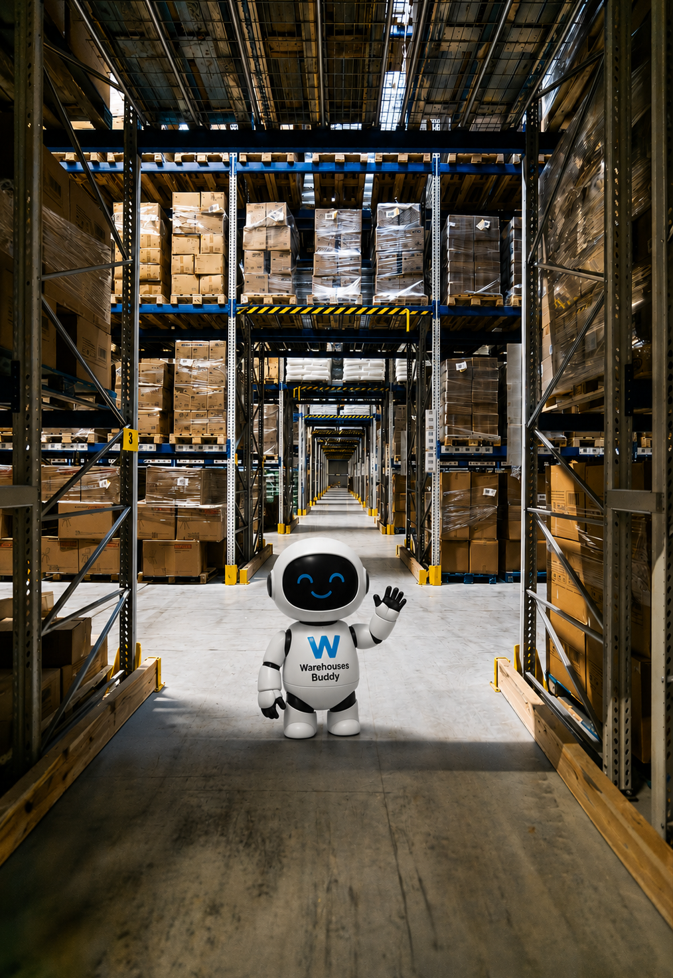
We have our first „robot” in stock.

At the start of 2026, I spent a few weeks in the warehouse office carrying out the duties of a logistics specialist. Yes, yes – I got it into my head that I wanted to learn how to work in a warehouse office. These specialists have a wide range of duties – they man the „warehouse counter”, where they deal with drivers coming to collect goods, as well as those delivering containers for transhipment or storage; they answer calls from customers, drivers, couriers and customs agencies, and they work on the WMS system. The whole process, however, revolves around the email inbox, which receives messages from over 100 customers currently served on a regular basis by Alfa Warehouses, including, above all, notifications of goods dispatched and received, enquiries, requests, documents, etc. After a few days, I became very tired and started imagining how this process could be automated – especially at times when six or seven notifications would arrive simultaneously to be added to the WMS, and entering just one takes at least 5–7 minutes. Drivers turning up to collect these goods, when the dispatch note hadn’t yet been added to the WMS, only added fuel to the fire and spurred me on to try and find a solution to eliminate these tasks.
The Alfa Group already has several automated systems in its portfolio – systems for debt collection mailings, a system in the documentation department, and a proprietary document workflow system with its own OCR, a system that finds the best rates for the customer – but we hadn’t come up with an idea for integrating work via email and within the WMS, and above all, for incorporating this into a single system that would read the email and add a notification in the WMS – ON YOUR OWN.
What the process was supposed to look like:
The machine reads emails and recognises collection notices
Searches for the following details: date, goods, quantity, driver’s details
Checks the customs procedure: ZC or T1
Checks that the documents are complete
He logs into the WMS and adds a delivery notification
Sends a confirmation to the customer
Sends customs documents to the Agency
If an error occurs, it explains the reason
It’s nothing, really 😉
Initial tests and challenges
We worked with Sebastian Wróbel, Wojciech Bakłażec and Szymon Kąkol on building the machine. Our first meeting with the programmers – we went through the process step by step, just as it says in the book. I think we came away from that meeting feeling that we knew what to do.
After a few days, I was contacted to attend the first test meeting, during which we went through the entire process step by step manually and checked whether the automated system was reading the data correctly. Wherever we spotted any inconsistencies, we introduced additional conditions to eliminate errors.
After two such meetings, we arranged a trial day – it was Tuesday at 10.00 – and we were waiting for the first emails notifying us of the releases. I remember that when the email with the dispatch notification arrived, I rushed into the warehouse office shouting, „Just make sure nobody adds the notification to the WMS – the system will do it automatically.”.
In the process preview, we could see that the data was being read correctly, but it turned out that the machine was having trouble logging into the WMS after all.
⚠️ WARNING! Error with automatic notification!
After several attempts, I suggested we try using a different login to see if we could add a delivery notice – sometimes the simplest things work, and believe it or not – it worked 😉😉
✅ Good morning,
Notification added.
Best regards
Alfa Warehouses
The next step was to send an email to the customer informing them that a dispatch notification had been added. It was only after a few days, during a conversation with the client, that I realised they had never received this automatic reply – the error was a minor one and was rectified immediately – but this showed me that it’s worth asking and checking everywhere, as appearances can sometimes be deceiving.
After a successful day, I decided that the next day we’d get the „robot” up and running first thing in the morning. I made sure everyone in the magazine’s office knew not to process the delivery notifications first thing in the morning but to leave them to the machine, and to make it seem a bit friendlier, I gave it a name Warehouse Buddy – everyone’s calling out at him today Buddy.
The first few days of testing – mistakes and successes
The big day has arrived – the first announcement…
⚠️ WARNING! Error with automatic notification!
WMS form error: Staff will not have enough time to handle loading/unloading
⚠️ WARNING! Error with automatic notification!
No available time slot with the minimum lead time for 7 May 2026 (all slots on Ramp B10 rejected – 3 attempts)
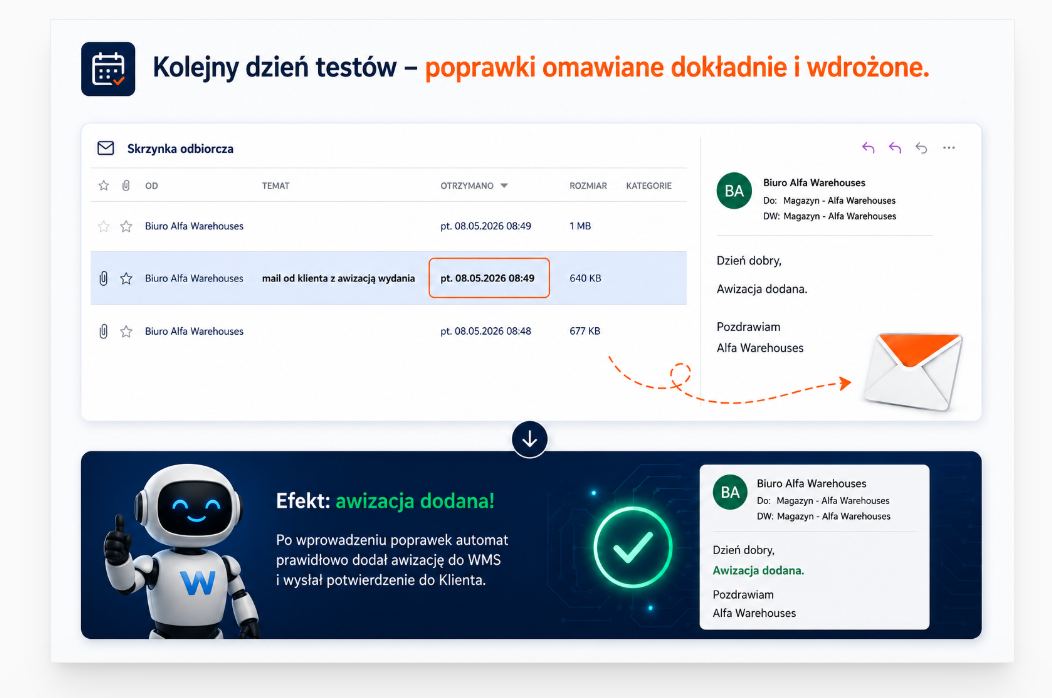
We were analysing the situation, but were stuck for ideas – in the end, I thought I’d pop down to the warehouse office and see if they could suggest anything. Bingo – it turned out that we needed to increase the number of loading bays so that the automated system could process the delivery notices efficiently. The change was added to the WMS in a couple of minutes, and we ran another test on Buddy:
✅ Good morning,
Notification added.
Best regards
Alfa Warehouses
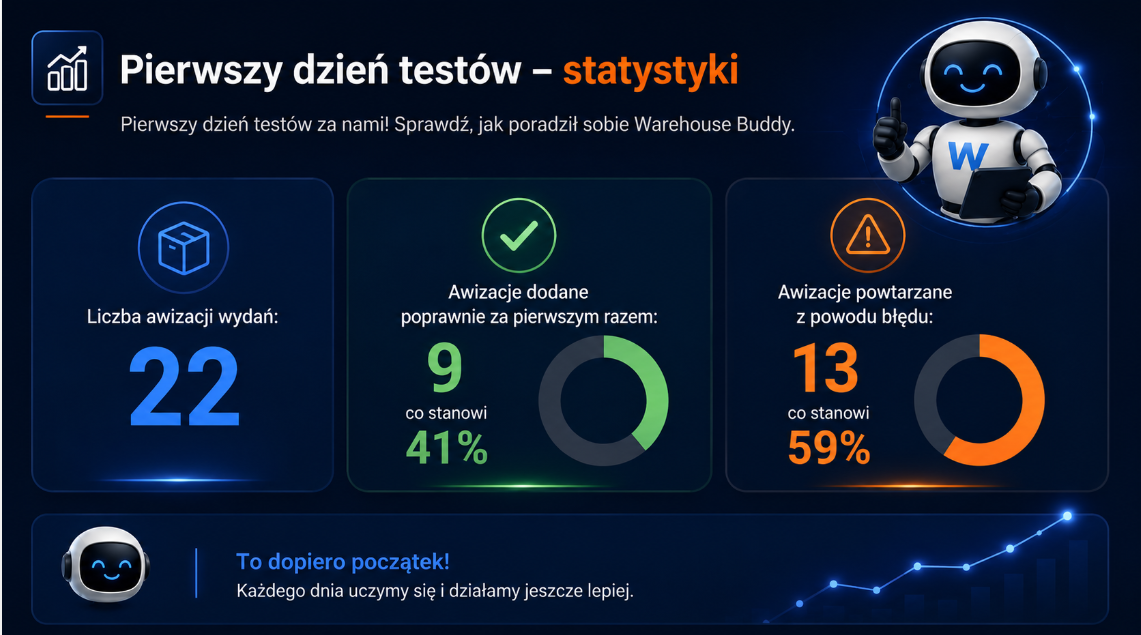
We finished the first day of testing with the following statistics:
Days two and three – 86% efficiency
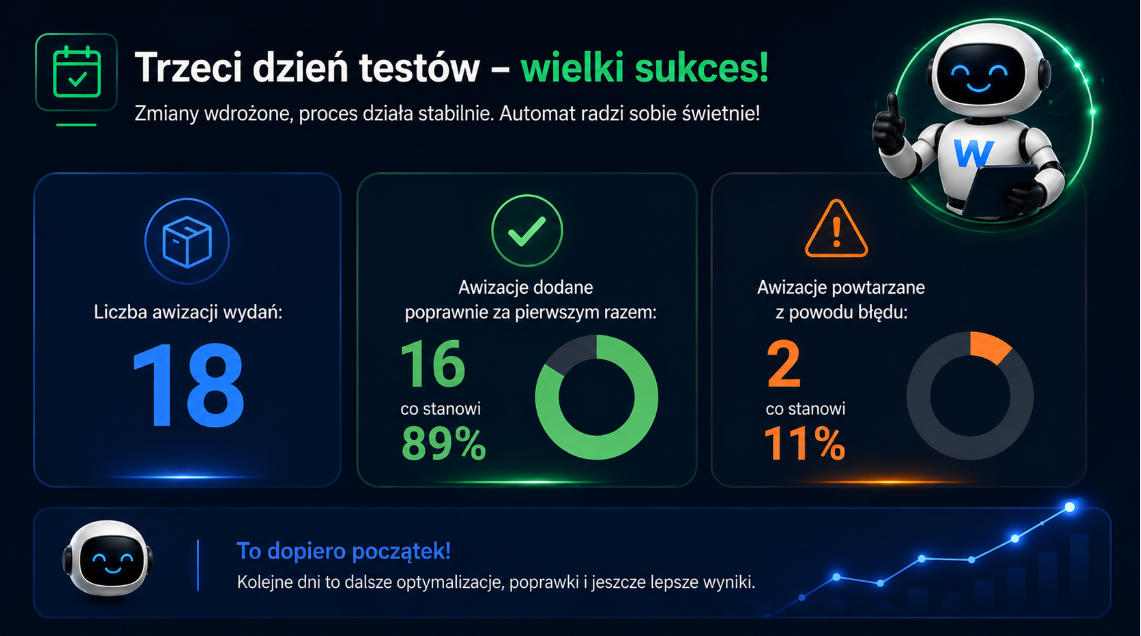
Another day of testing – the changes were discussed in detail and implemented. On that day 86% notifications has been added correctly. Day three proved to be a great success, despite the two remaining issues:
- Buddy mixed up emails without release notifications – 6% errors
- Attachments without a specific name were rejected – 2% errors
Solution: standardisation of document naming conventions by the client + an additional recognition criterion (the keyword „issue, release”). One problem was resolved the very next day.
Day four – the machine’s weakest day
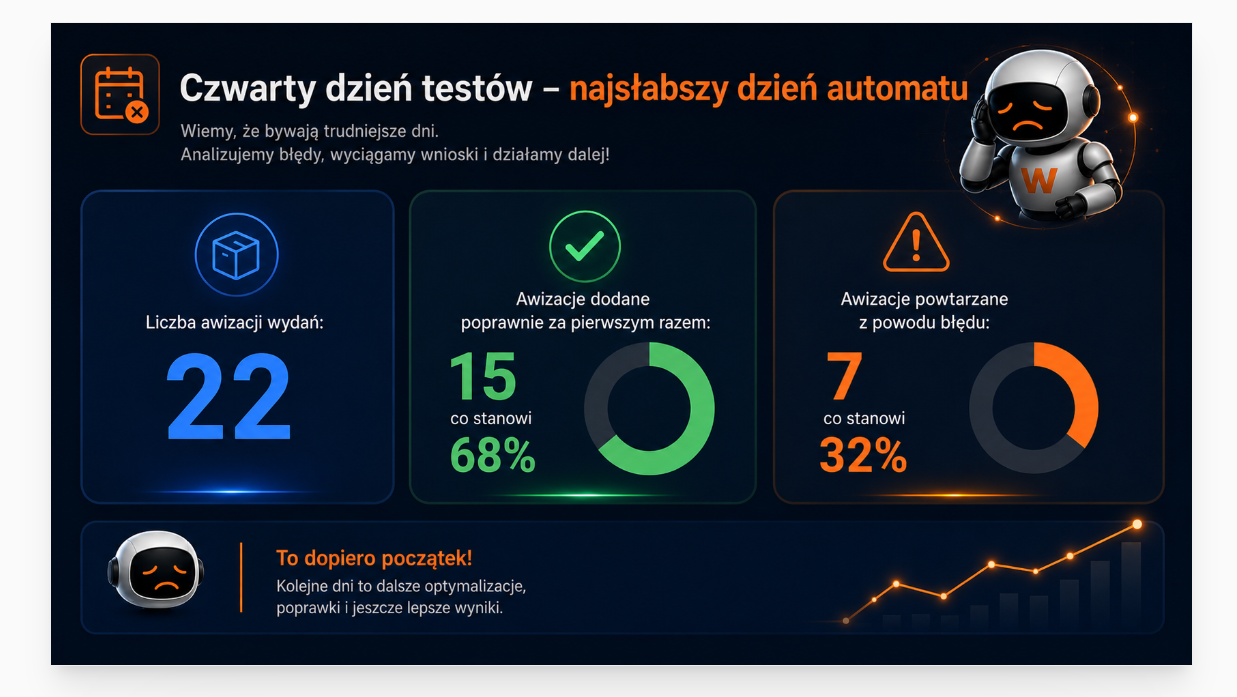
Suddenly, the very same errors that we had already fixed started to reappear, and on top of that, Buddy began treating all emails that weren’t releases as releases.
At 3.00 pm, I was feeling very frustrated ☹. A quick text to the developers, their immediate response, and by 3.02 pm we were back on Teams, going through each case one by one again.
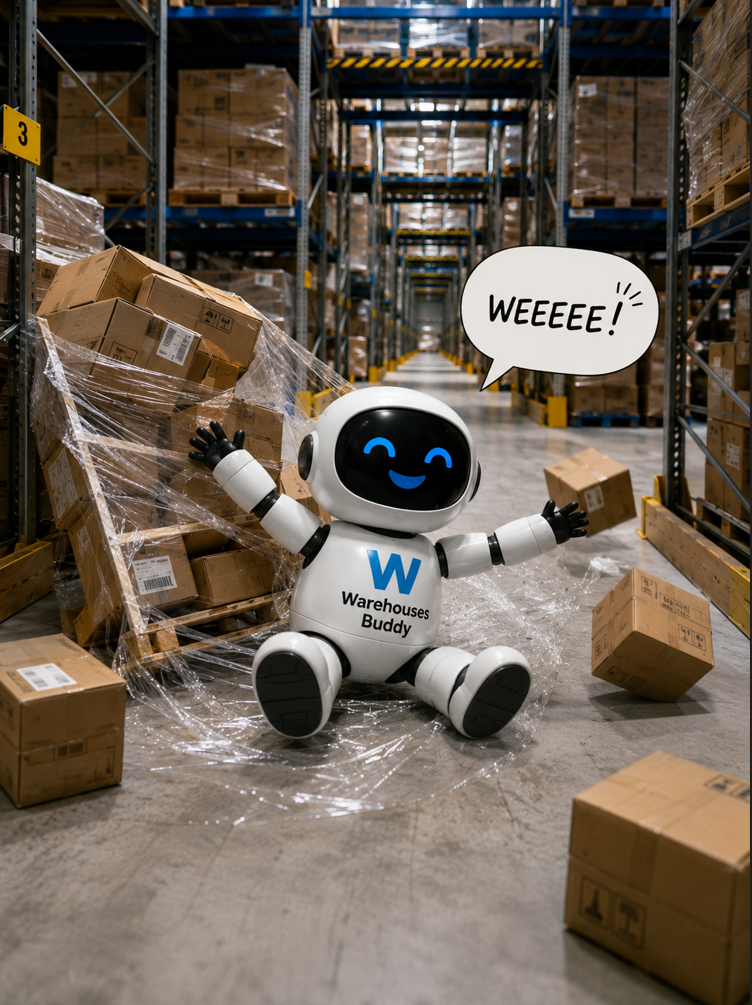
Day five and beyond – implementation statistics
More new bugs – and the cycle repeats itself – fix, deployment, testing. The coming days and weeks will be spent on further fixes and testing.
| Day 1 | Day 2 | Day 3 | Day 4 | Day 5 | Day 6 | Day 7 | Day 8 | |||||||||
|---|---|---|---|---|---|---|---|---|---|---|---|---|---|---|---|---|
| Number of issue notices | 22 | 28 | 18 | 22 | 21 | 30 | 22 | 12 | ||||||||
| Notifications added successfully the first time | 9 | 41% | 24 | 86% | 16 | 89% | 15 | 68% | 15 | 71% | 25 | 83% | 18 | 82% | 12 | 100% |
| Notifications repeated due to an error | 13 | 59% | 4 | 14% | 2 | 11% | 7 | 32% | 6 | 29% | 5 | 17% | 4 | 18% | 0 | 0% |
I know plenty of larger companies that don’t have anything like this. In the day-to-day rush, Buddy is a real help because it works very quickly. It takes us about 5 minutes to add a dispatch notification, but it does it in a few seconds – within a minute of receiving an email from customers. It saves a huge amount of time.
— Warehouse office staff
And perhaps I should be boasting about 100%’s track record from day two onwards, but I believe that direction and reliability are what matter most. We don’t have a 100% track record every day – not yet, anyway 😉. But we’ve learnt a valuable lesson.
The process of creating and rolling out Buddy has been an incredible lesson in consistency, patience and humility – for the developers too. The sense of satisfaction at the end, however, is immense.
Every day, the magazine’s editorial office waited for the statistics and offered their own suggestions on how to help. Sebastian Wróbel, Wojciech Bakłażec and Szymon Kąkol showed extraordinary commitment and understood that „we don’t take prisoners” 😉. Thank you for your patience and for pushing through to the end.
After a few days, I freed up a significant amount of time for the warehouse office staff to handle dispatch notifications, which has created more scope for talking to customers, analysing documents or assisting drivers.
💬 „Will Buddha be supporting us today too?” 😊
— Warehouse office staff, third day of testing
What lies ahead?
The second stage of the project lies ahead of us – rolling out Buddy to all warehouse clients, followed by the automatic sending of delivery notes and photographs. To sum up, the most important thing about automation is to implement changes that are desired by staff, deliver value to the client and, ultimately, result in cost savings.
Katarzyna Kisielewska
Chairman of the Management Board, Alfa Warehouses


 Polish
 English
 Ukrainian
 German
 Swedish